
As a business owner, accepting credit cards is essential to staying competitive and meeting customer expectations. But many owners are frustrated by the credit card processing fees that eat into profits every month. Learn how our dual pricing solutions can help you reduce these costs. These charges result from a complex network involving your bank, the customer’s bank, and major credit card networks such as Visa and Mastercard. All of these entities maintain the infrastructure that enables secure electronic payments.
The total cost, known as the Merchant Discount Rate (MDR), is applied as a percentage of each transaction. Factors such as transaction type (in-person, online), card type (debit or credit), and more influence the final fee. Traditionally, merchants have absorbed these processing fees as overhead. Because the fee is a percentage of the total purchase, monthly processing fees can quickly add up to thousands of dollars.
Credit card processing fees directly impact profit margins, operational efficiency, and pricing strategy. For low-margin businesses—such as those with a 10% net profit—processing fees can account for up to 30% of total income. In today’s competitive marketplace, accepting credit cards is non-negotiable, but there is a way to offset these costs and boost your bottom line: dual pricing.
Related: How to Choose the Best Payment Processor for Your Business
What is Dual Pricing?
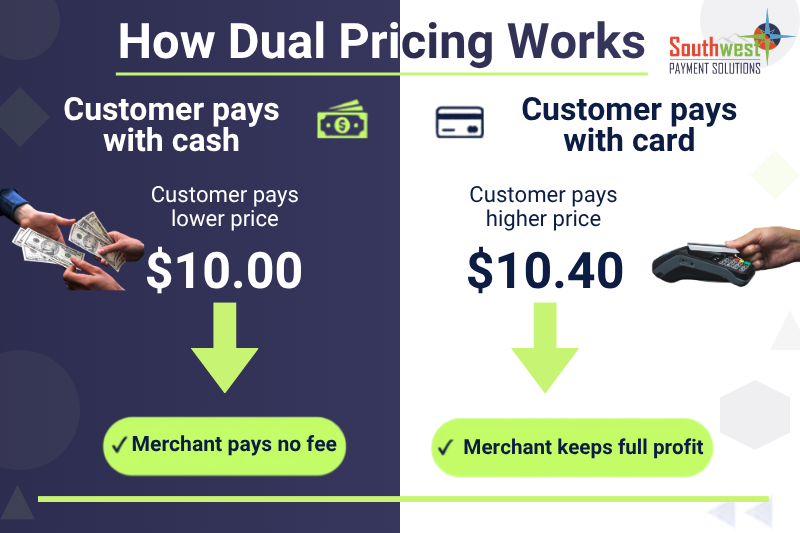
Dual Pricing is a payment processing strategy that offers two prices for the same product or service: a standard price for credit or debit card payments (which includes the processing fee), and a discounted price for customers who pay with cash. This empowers customers to choose their preferred payment method while helping your business reduce overhead costs and improve cash flow.
Dual Pricing vs. Surcharging
Both dual pricing and surcharging help merchants manage payment processing fees, but they are not the same. Dual pricing displays two clear prices (cash vs. card), while surcharging adds a fee to credit card transactions at checkout. Dual pricing is more transparent and is legal in all 50 states, while surcharging is not allowed everywhere and is prohibited on debit card transactions.
Dual Pricing in Practice
A common example of dual pricing is at the gas pump, where signs display one price for cash and another for credit. Retail stores and restaurants may also display both prices on menus or signage, making the model clear as soon as customers enter. Transparency is crucial: customers should see the discounted cash price upfront so they can make an informed decision before payment.
What are the Benefits of Dual Pricing for Business Owners?
Key Takeaways (Shareable Summary):
– Dual pricing can significantly reduce credit card processing fees.
– Transparency with customers builds trust and loyalty.
– Offers a competitive edge through flexible pricing.
– Supports profit margins and operational efficiency.
Dual pricing is more than just a cost-saving tactic—it’s a comprehensive business strategy that can transform the way you operate, interact with customers, and stand out in your market. Here’s a deep dive into the core benefits of implementing dual pricing in your business:
Cost Savings and Increased Margins
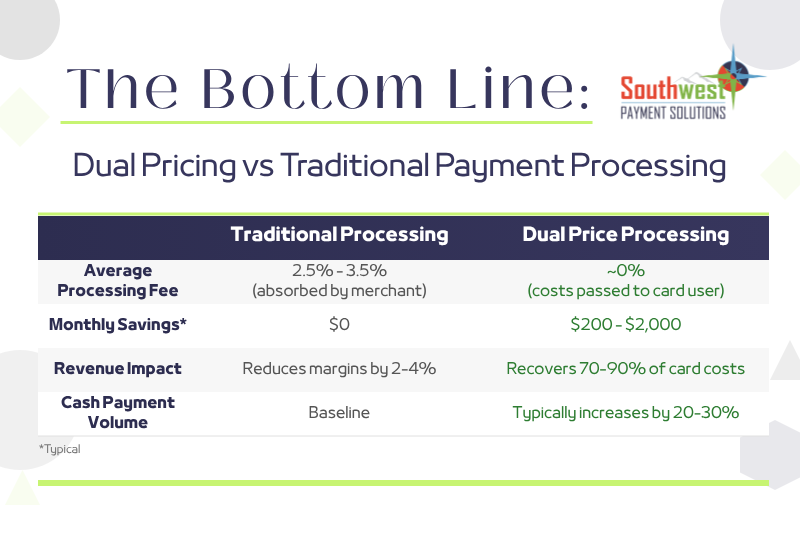
One of the most significant benefits of dual pricing is the potential for substantial cost savings and increased profit margins. Traditional credit card processing fees can take a considerable bite out of every sale, especially for businesses operating with thin margins. By adopting a dual pricing model, business owners can shift these fees to customers who choose to pay by card, while offering a cash discount to encourage alternative payment methods.
One of the most significant benefits of dual pricing is the potential for substantial cost savings and increased profit margins. Traditional credit card processing fees can take a considerable bite out of every sale, especially for businesses operating with thin margins. By adopting a dual pricing model, business owners can shift these fees to customers who choose to pay by card, while offering a cash discount to encourage alternative payment methods.
Consider this: If your business processes $10,000 in monthly card sales and pays an average of 2.5-4% in processing fees, you could be spending $3,000 to $4,800 annually just to accept cards. Set up a free consultation to see how much your business could save. With dual pricing, you retain more revenue from each card transaction, which can add up to thousands of dollars in savings each year. This extra capital can be reinvested into your business—hiring staff, upgrading equipment, expanding inventory, or launching marketing campaigns. For businesses in highly competitive industries, these savings can be the difference between profit and loss or the key to sustainable growth.
Dual pricing also provides greater financial predictability. By reducing volatility from fluctuating card fees, you can better forecast expenses and set pricing strategies with confidence.
Moreover, increased margins from dual pricing can make it easier to offer competitive prices, run promotions, or absorb other operational costs without compromising profitability. For low-margin businesses such as convenience stores, gas stations, and quick-service restaurants, dual pricing can be the lifeline that keeps their doors open and their business thriving.
By shifting payment processing fees to cardholders, business owners can protect their already narrow margins and avoid raising prices across the board. For many convenience stores and quick-service restaurants, dual pricing enables them to offer affordable options to price-sensitive customers while covering the costs of card payments.
Transparency with Customers
Dual pricing offers a new level of transparency in how businesses communicate costs to their customers. Unlike hidden surcharges or undisclosed fees, dual pricing clearly displays both the cash price and the card price for each product or service. This upfront honesty builds trust with customers and prevents surprises at the checkout counter.
This approach also helps educate customers about the true costs of card payments, thereby shifting consumer behavior over time. For so many years, cardholders received the FULL benefit of rewards cards while merchants had to eat the additional cost and further erode margins. As more customers become aware that card fees directly impact prices, they may opt for cash more frequently, further increasing your savings and reducing your reliance on costly card processing networks.
Customers appreciate having a choice of payment methods. Dual pricing boosts transparency by clearly displaying both cash and card prices upfront, reducing surprises at checkout and building trust. Customers who pay with cash also enjoy a direct discount.
Competitive Advantage
Adopting dual pricing can give your business a unique competitive advantage in the marketplace. In addition to cost savings and transparency, dual pricing enables you to position your business as customer-focused and innovative.
With dual pricing, you can offer lower cash prices than competitors who only accept cards or who hide fees in their pricing. This can be especially appealing to price-sensitive customers, such as students, seniors, or budget-conscious families. See how our clients have gained a competitive edge with dual pricing. By marketing your cash discount program through in-store signage, digital marketing, and word of mouth, you can attract new customer segments and increase foot traffic.
In certain industries, dual pricing has become a market differentiator. For example, gas stations that advertise cash discounts often draw more customers, as do restaurants and retailers who promote transparent, fee-free pricing for cash purchases. Highlighting your dual pricing model can set you apart from competitors and foster customer goodwill.
Dual pricing also empowers your business to adapt to changing payment trends. As more consumers become aware of processing fees and seek ways to save, offering a tangible benefit for cash payments can keep your business relevant and resilient. Ultimately, dual pricing not only boosts your bottom line but also positions you as a forward-thinking leader in your industry.
Reducing or eliminating credit card processing fees allows your business to enjoy stronger margins, better cash flow, and attract price-sensitive shoppers with lower cash prices. Dual pricing can give you a competitive edge and foster stronger customer relationships by empowering them with choice.

Potential Challenges and Considerations
1. Customer Perception and Transparency
Clear communication is essential when implementing dual pricing. Staff should be well-trained to explain the pricing difference and address any customer questions.
2. Technology and Point-of-Sale
Your point-of-sale (POS) system needs to support dual pricing, displaying both cash and card prices clearly to avoid confusion.
Successfully implementing dual pricing requires transparency with customers and robust technological support. By ensuring staff can clearly articulate the reasons for price differences and using a POS system that displays both pricing options without ambiguity, businesses can foster trust and minimize confusion. Our experienced team can guide you through each step of the dual pricing implementation process with tailored recommendations and ongoing support. Ultimately, these steps help create a smoother transition to dual pricing, benefiting both the business and its customers.
A Detailed Breakdown of Legal and Compliance Considerations for Dual Pricing
Dual pricing is legal and available in all 50 states. There are specific federal, state, and card network regulations that must be adhered to to remain compliant. Below, we break down the key considerations:
1. Federal Regulations
– The Durbin Amendment and Dodd-Frank Act provide the legal framework for cash discounts and prohibit surcharges on debit card transactions. Dual pricing, when executed as a true cash discount (not a surcharge), aligns with these federal laws.
2. State Laws
– While dual pricing is legal everywhere, surcharging is not legal in all states. Some states (such as Connecticut and Massachusetts) have restrictions on adding surcharges to card transactions, but these do not apply to dual pricing.
3. Card Network Rules (Visa, Mastercard, American Express, Discover)
– Card networks require that dual pricing be presented as a discount for cash, not as a penalty for card use. This means you must clearly display the higher “card price” and the discounted “cash price.”
– Signage requirements: Visa and Mastercard, for example, require clear and conspicuous signage at the point of entry and point of sale to inform customers of both prices and the availability of a cash discount.
– Pricing parity: The price difference must accurately reflect the cost of card acceptance and cannot be arbitrary or excessive.
4. Transparency & Disclosure
– Businesses must ensure that both cash and card prices are clearly posted, and that staff are trained to explain the pricing difference to avoid confusion or complaints.
– All advertising, menus, or online listings should reflect dual pricing when applicable.
– Receipts should show the payment method and the price paid to provide transparency and for record-keeping.
5. Implementation Pitfalls to Avoid
– Do not add a “service fee” or “convenience fee” to card payments unless permitted by law and card network rules. That is a surcharge and may be illegal in some states and under federal law.
– Avoid calling the card price a “fee” or “penalty”—always refer to the cash price as a discount.
– Make sure your POS technology can handle dual pricing and update your signage, receipts, and staff training accordingly.
6. Staying Up-to-Date
– Laws and card network rules change periodically. Subscribe to industry updates or work with a payments consultant or legal advisor to ensure ongoing compliance.
7. Resources for Business Owners
– Card network guidelines: Visit Visa, Mastercard, American Express, and Discover’s official merchant pages for up-to-date rules.
– State government websites: For state-specific regulations.
– Trade associations: Many industry groups offer compliance resources and legal updates. Contact our compliance experts if you have questions about implementing dual pricing in your business.
– More Resources: Visa Merchant Dual Pricing Rules , FTC: Credit Card Surcharges
By understanding and complying with these legal and compliance requirements, businesses can confidently implement dual pricing. Should you have any questions, consult with a payment expert or an attorney familiar with merchant services law.
Conclusion
Just as you pass on other costs to your customers, passing on card processing fees is no different. Dual pricing can save your business a lot of money and let you apply those savings to your business as more inventory, higher wages, or even just increased margins. By clearly presenting both cash and card prices, you not only empower customers to make informed payment choices but also safeguard your profit margins in an increasingly competitive landscape.
As we’ve explored, the benefits of dual pricing go far beyond cost savings—they include stronger customer relationships, increased trust, and a measurable competitive edge. At the same time, success with dual pricing requires careful attention to legal compliance, staff training, and technology integration. When implemented thoughtfully, dual pricing can transform your business operations, strengthen your financial foundation, and help you thrive in today’s evolving payments environment.
If you’re ready to reduce expenses, boost your bottom line, and deliver a more transparent customer experience, consider making dual pricing part of your payment strategy. Stay informed, follow best practices, and seek expert advice as you make this transition—your business’s future profitability may depend on it.
Frequently Asked Questions (FAQ)
1. Is dual pricing legal in all states?
Yes, when implemented as a true cash discount, dual pricing is legal in all 50 states. Always ensure compliance with state and card network rules.
2. How do customers react to dual pricing?
Most customers appreciate the transparency and the opportunity to save by paying with cash. Clear communication and staff training help ensure a positive response. Dual pricing is becoming increasingly commonplace, and customers are growing accustomed to the small fee for the convenience of a card.
3. Does dual pricing reduce sales?
When implemented transparently, dual pricing does not negatively affect sales and can even attract price-sensitive customers.
4. Is dual pricing hard to set up?
No! With the right POS system and updated signage, implementing dual pricing is straightforward. Staff training and ongoing compliance checks are recommended.
Ready to start saving on credit card processing fees? Contact us today to learn how dual pricing can work for your business, or download our free implementation checklist to get started!
Actionable Checklist: Implementing Dual Pricing in Your Business
Dual pricing can unlock new revenue opportunities and enhance your competitive edge, providing greater flexibility and tangible value for both you and your customers. This guide offers a step-by-step checklist to ensure a seamless adoption of dual pricing, maximize its benefits, and achieve a smooth transition at every stage.
At Southwest Payment Solutions, we leverage our experience and in-depth knowledge to ensure your transition to dual pricing delivers maximum results for your business. If you have any questions or would like a complimentary consultation, our dedicated team is ready to provide expert advice and support at every stage.

Assess Your Current Payment Processing Fees
– Review monthly statements to understand the true cost of card processing
– Identify how much you could save with a dual pricing model.

Choose Card Processing Partner
– Choose a card processing partner with experience in dual pricing card processing.
– Review Visa, Mastercard, and other card issuer signage, disclosure, and receipt requirements.

Choose a Capable POS System
– Ensure your point-of-sale system can display both cash and card prices.
– Work with your POS provider or processor to enable dual pricing features.

Update In-Store and Online Signage
– Clearly display both cash and card prices at the point of entry and point of sale.
– Update menus, price tags, and online listings to reflect dual pricing.

Train Your Staff
– Educate employees on how dual pricing works and how to explain it to customers.
– Prepare staff to address common questions or concerns.

Communicate Transparently with Customers
– Use clear, positive language to present dual pricing as a cash discount—not a penalty for using cards.
– Offer simple explanations and printed materials if needed.

Monitor Customer Feedback and Sales
– Track how customers respond to dual pricing.
– Watch for changes in payment method preferences and overall satisfaction.

Stay Informed and Compliant
– Periodically review your compliance with laws and network rules.
– Work with your Merchant Services provider to maintain compliance

Analyze Results and Adjust as Needed
– Review savings, margins, and customer satisfaction regularly.
– Make adjustments to your pricing, training, or signage based on results.
